

The Book:
Strategy: A History
By Lawrence Freedman
Oxford University Press
2013
The Talk:
In his 2013 book Strategy: A History, historian Lawrence Freedman traces the evolution of strategy from chimpanzees to the Iraq War.
This 600-page doorstop of a book is divided into three main sections—on warfare, politics, and business—in which Freedman describes the major themes, patterns, and foibles of (often self-proclaimed) strategists through the ages.
Mostly the book focuses on the 19th and 20th Centuries, and for good reason:
Napoleon’s army marked a new era in military organization; much of military strategic thinking, even well into the mid-20th century, centered around unpacking the principles behind Napoleon’s victories (as interpreted mainly by Clausewitz).
Similarly, the French Revolution was a kind of Genesis moment for social reformers and revolutionaries, shaping much of socialist thinking about what was politically feasible.
Finally, the 19th Century was also saw the rise of the modern corporation, which led to titanic struggles between a new kind of elite and a new kind of labor, and the search for a tolerable status quo between them.
One of themes of the book is the post-Enlightenment search for a universal strategy—a method that, when systematically applied, leads to winning. If only we could look at things rationally, scientifically, mathematically, so the thinking goes, we could know the certain path to victory. Many books have been written promising these principles, but the desire is always frustrated; partly because opponents adapt to winning strategies, making them progressively less effective, and partially because the world is complex, and winning or losing often comes down to specific details in a situation, which cannot be found in any book.
All that said, if there is any concept that stood out to me most, it is the way coalition building (and its inverse, coalition breaking) are central to victory across domains. Freedman writes in his preface:
Combining with others often constitutes the most astute strategic move; for the same reason, preventing opponents from doing the same can be as valuable.
Allies win wars
Napoleon was good at winning battles. His pattern was to win campaigns so fast and so decisively, he could sue for generous political terms in the aftermath. (This is how Russia defeated him, by denying him, above all else, a fast and decisive outcome.)
What Napoleon struggled with was building alliances. It was likely due in part to his personality and in part to the horror of the French Revolution that he embodied for European leaders. But the story of the Napoleonic wars is basically a series of coalitions against Napoleon, and Napoleon’s inability to build a coalition for himself.
Napoleon lacked political subtlety. He inclined toward punitive peace terms and was poor at forging coalitions.
The fact that Napoleon ended up at Waterloo is telling in itself. Napoleon escapes Elba and tries to win one more battle, perhaps to gain some temporary truce or renegotiated terms. But there was no way he could’ve defeated the coalition against him in any permanent way. Victory would’ve simply delayed the inevitable.
Along the same lines, during World War II, when Churchill came into power, his number one goal was partnership with the United States. Freedman writes:
Almost immediately after taking office, Churchill saw that the only way to a satisfactory conclusion of the war was “to drag the United States in,” and this was thereafter the center of his strategy. His predecessor Neville Chamberlain had not attempted to develop any rapport with President Franklin Roosevelt. Churchill began at once what turned into a regular and intense correspondence with Roosevelt...
Churchill later wrote about his rejoicing when America entered the conflict:
So we had won after all! … How long the war would last or in what fashion it would end, no man could tell, nor did I at this moment care… We should not be wiped out. Our history would not come to an end.
Similarly, after World War II, even with potentially world-ending nuclear weapons in play, the shape of the Cold War was defined by the building of coalitions (like NATO and the Marshall Plan) and denying the enemy allies (containment).
We may also consider recent wars as well: Israel’s alliance with the U.S. makes Israel far more powerful militarily than its military ever could. Iran’s bombing of Arab states is an attempt to break their partnerships with the United States. The war in Ukraine started over Russia’s fears about Ukraine aligning itself with Europe, and Ukraine’s survival depends on its ability to nurture alliances with other countries. Wartime president Zelenskyy appears to spend nearly all his time making deals with countries all over the globe.
In short, military action is often in the service of building or breaking alliances. Indeed, the combining of forces alone can be sufficient for victory. At Waterloo, Napoleon needed to defeat the British by themselves before Prussian forces could join with Wellington. Once the two countries combined forces, the battle was over.
Workers of the world, unite!
Reading Freedman’s section on political strategy, it seems like Karl Marx was his own worst enemy. He was an extremely vicious and caustic personality. It was only later in his life when he toned down his vitriol against other socialists that he made any meaningful headway in making his theories influential. And it was really only after Marx died that Marxism was picked up by talented social operators like Lenin and Stalin to produce an actual communist revolution.
When we take a broad historical view, non-revolutionary worker organizations and unions won smaller but lasting gains for workers over decades. These were still hard fought, but worker conditions did improve over time. The workers’ power came from their ability to build durable institutions, not their ability to precisely predict the future a la Marx.
In a completely different way, the Civil Rights Movement of the 1960s in America was built as an alliance of Black churches.
The churches were the only local institutions independent of white society, financed and run by blacks.
Black churches provided the power base for effective action. Martin Luther King Jr. was a minister surrounded by strategists and organizers like Bayard Rustin who created the Southern Christian Leadership Conference, an organization of ministers. The “movement” was by no means spontaneous. Rather it was highly structured, disciplined, and regimented, an organization of organizations.
The lack of this structural element may be why peaceful protests in the 21st Century, though inspired in many ways by the Civil Rights Movement, have sometimes proven less effectual.
“What kind of bayonets?”
In his section on business strategy, Freedman deals with external strategy (i.e. markets) and internal strategy (i.e. management). In both of these categories, the 19th and 20th Centuries were dominated by the overwhelming power of coalitions. For markets, trusts and trust-busting. For management, unions and union-busting.
Trusts developed in the 1880s as secret agreements, allowing coordination between companies. John D. Rockefeller, who Freedman describes as “undoubtedly a master strategist,” built the largest and most notorious of the trusts. When the 1890 Sherman Antitrust Act was passed, Rockefeller’s Standard Oil developed new arrangements in order to work around the legislation, establishing new “independent” companies that were not truly independent. Even after it was ordered dissolved in 1909, it took a Supreme Court ruling in 1911 to finally break Standard Oil into 34 companies.
Robber barons weren’t the only one’s who could organize, however. Freedman describes the 1936-7 autoworkers strike against General Motors in Flint, Michigan which spread across the Midwest. The strike required not only sit-in strikers but supply lines for heat (it was winter) and food. It wasn’t just about anger or willpower, but practical coordination.
Government officials and business leaders threatened violence but also worried how they would look to the public with blood on their hands. John Lewis, the leader of the CIO, mocked them: “What kind of bayonets, Governor Murphy, are you going to turn around inside our boys?” General Motors eventually gave in and the UAW won exclusive bargaining rights.
The moral of successful labor strikes and the Civil Rights Movement is not that non-violence is an effective strategy per se, but rather that a sufficiently robust coalition can blunt the effectiveness of an opponent’s violence, even to the point of irrelevance.
The world is not a betting market
It is common these days for people to think of strategy in terms of poker: A series of probabilistic bets about the future made by individuals with private knowledge who are attempting to deceive one another.
Similarly, game theory, so popular today, developed out of the Cold War as an attempt to think through conflicts where individuals were self-interested, did not share knowledge, and could not trust each other.
Even positive ideas like effective altruism are often presented as a single person making an individual financial contribution, similar to a bet, in order to do the most good with their one life.
Bayesian logic has crept into casual conversation. People “update their priors” now, and everyone wants to know if you would “take the over/under” on future political events. All these social fashions signal to others that you are smart, calculating, and savvy.
Certainly strategy has to do with the future, and so predictions play a role in the decisions human make. However, Freedman’s book made me realize how limited prediction (and similarly bluffing) is as a basis for strategic thinking. I recognize now how rarely my own strategic thinking starts with coalitions. Who can help me? Who’s my team? What team can I join? Where are my allies? To think like Churchill: Who, if I had them in my corner, would make my own success inevitable?
And similarly (for let’s be honest): How do I isolate my enemies? How do I peel off their allies? How do I win over their friends (or at least turn them neutral)? How do I disrupt their ability to organize?
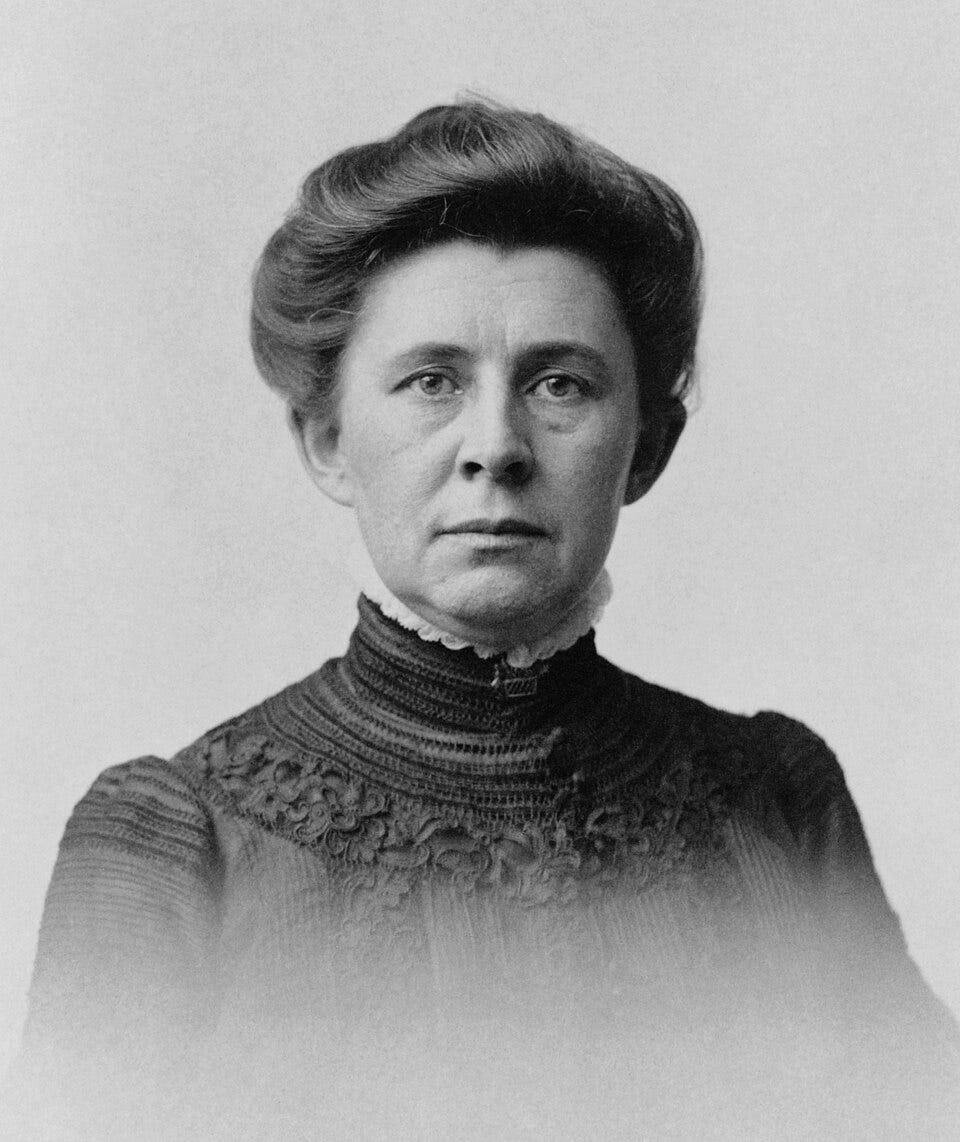
Perhaps muckraker Ida Tarbell is an example to follow; her History of the Standard Oil Company made secret partnerships public, and thus contributed to Standard Oil’s fall and the creation of the Federal Trade Commission which has lasted over a century.

The benefit of thinking in coalitions, rather than thinking in bets, is that it doesn’t require getting the future exactly right. You may fail to predict events or opponent reactions. Your deceptions and bluffs may fail. Your plans may unravel. Your analogies to past events may breakdown. Your goals may change. But coalitions increase your power significantly regardless. Coalitions are the power, in a way; they are the shape and structure of social reality that determine what endures and what dissipates over time.
To think about strategy in terms of isolated individuals making bets on the future is to miss the game of power entirely. Truly, everywhere you look, people with horrible track records at predicting the future remain ensconced in power. How can this be so unless predictions have little to do with winning in the real world?
Coda: The narrative twist
So how does one go about building coalitions and institutions? One of the major themes of Freedman’s book is that a strategy is often a plausible story about the future that motivates people to take action and tells them their place in the narrative so they know how to act.
In large corporations executives never have the power to control the behavior of every single person. Thus, from one perspective, all executive strategy is bound to fail if understood as a description of future actions. Rather strategy can tell people what role they are playing so that when novel or unexpected events occur, people know what to do in response (i.e. what their “character” does in the story).
As a story, strategy motivates and coordinates large groups of people to act in concert toward a particular end while not having to give direct orders, describe the details, or predict the future. It’s a story about the future that is predictive only in the sense that its telling increases the likelihood of its narrative coming into being.
This is quite a different way of thinking about strategy than appealing to self-interest, as in game theory. And it may explain why many people behave in ways that appear contrary to probabilistic or self-interested logic in service to the goals of groups and institutions to which they pledge allegiance: They feel themselves as characters in a compelling story, and the story tells them what to do.
In conclusion, people win by building coalitions and breaking the coalitions of their enemies. Coalitions are often built through plausible yet compelling stories about the future. It may be worth it, for the student of strategy, to further study how stories are broken and how to break them.
Related:
How subjective things become objective
The Tao Te Ching is a political document
When boys ruled Halloween ←An interesting historical case of how community organizations banded together to change the meaning of a centuries-old holiday